
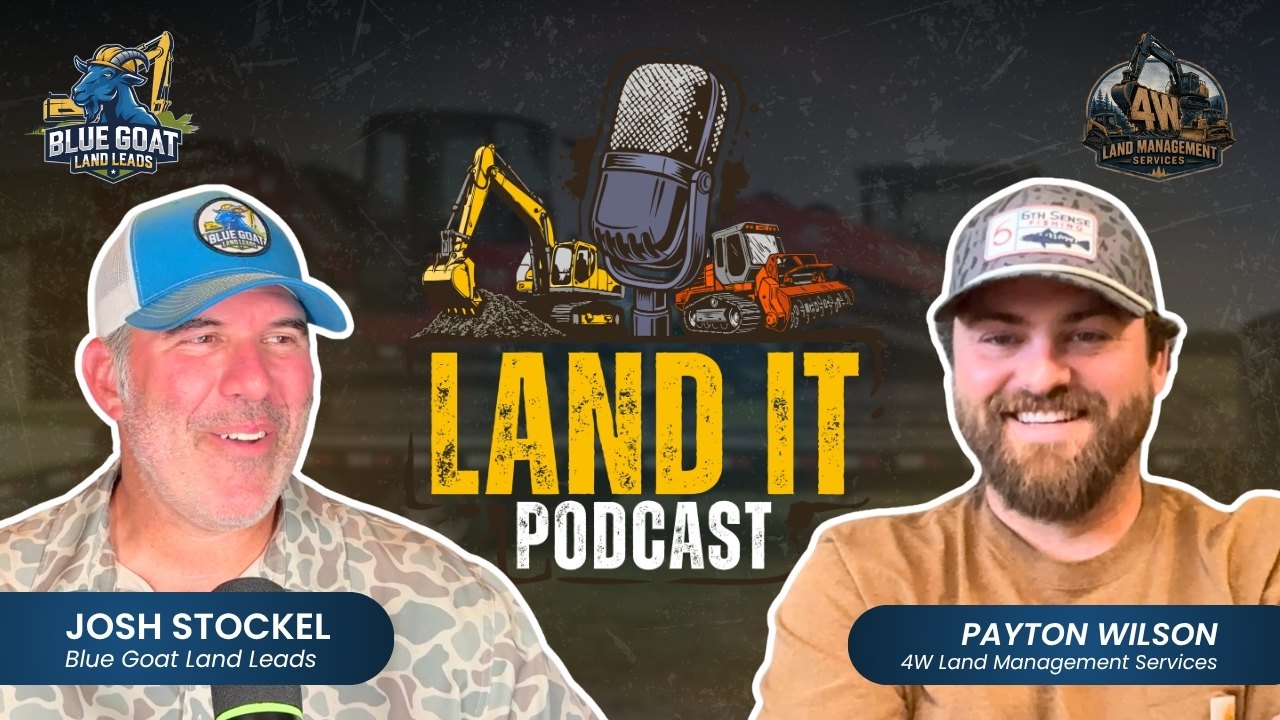
A varied operation across three counties
Payton describes 4W's work spanning mulching, clearing, house pads, drainage, ponds and excavation. His background with farmers and ranchers helped expose him to land and water projects beyond a single-service clearing business.
A bad estimate changed how he quotes
After discovering more downed timber than expected on an early clearing job, Payton moved away from assuming a fixed number of days. He now explains an estimated schedule and a cap, with the customer paying for the actual shorter duration when work finishes early.
Play episode 15.
Katie keeps inquiries and finances organized
Payton says Katie records the calls, job details and dates he relays from the field and helps manage the money side of the company. They use their different strengths to keep follow-up and decisions from getting lost during busy days.
Add services with skills and partners
Payton describes learning new work, renting equipment before committing to purchases and calling trusted specialists when a job exceeds his capacity. Relationships with real-estate contacts and other contractors also generate referrals and complementary scopes.
A booked first job made the initial machine decision possible
Payton says a friend's call about a potential project pushed him from considering land work to pursuing it seriously. He had the job bid before he owned the skid steer and mulching equipment, and borrowed a flatbed trailer from his father-in-law to move the machine. He describes piecing the operation together around that first committed scope, then doing the work and getting paid, rather than beginning with a fleet and waiting for customers to appear. It is a story about timing and support, not a universal financing recipe: the project and the borrowed trailer were circumstances particular to his start. His account explains why early equipment choices should follow a realistic opportunity, not just enthusiasm for owning iron.
See the full conversation.
Nearby contractors can be referral partners, not just rivals
Payton describes sending oversized opportunities to established operators with larger equipment instead of pretending his own crew can handle every job. Some of those contractors later send him work suited to his skid steer or call him for a related scope they do not want to perform. He gives an example of working alongside a friend who pours concrete while Payton builds the pad. That reciprocal network can preserve a customer's project even when one business cannot provide every trade. It also depends on trust: the interview emphasizes being candid about capacity and doing the referred work well. The relationship is more durable when neither party treats every incoming call as a job to hoard.
Plan the repair reserve before adding iron
Near the end of the conversation, Payton urges prospective owners to research what maintaining a machine will cost over a year's expected use and to keep a substantial reserve for surprises. His concern is the contractor whose work stops when a repair is needed because every available dollar went into acquiring the equipment. He applies that thinking beyond the largest machine, mentioning attachments and smaller tools as part of the cost of operating. He also says there is no shame in renting while learning whether the work and the demand are a good fit. The point is not that ownership is wrong; it is that payments, wear and downtime have to fit the actual business.
Ideas to take back to the work
- Inspect uncertain vegetation and ground conditions before assuming a production rate.
- Spell out how estimated days, early completion and overruns affect the customer's bill.
- Use trusted partners and rentals to test demand rather than owning every capability from the start.
Questions from this conversation
How does Payton handle an uncertain duration in a clearing bid?
He describes estimating enough days to protect against surprises, charging for fewer days if the work finishes early and absorbing time beyond the agreed cap.
What role does Katie play in 4W?
Payton says she tracks information from incoming calls and jobs and handles much of the financial organization while he works in the field.
Why does 4W offer more than mulching?
Payton describes customers needing connected work such as pads, drainage and ponds; he learns suitable scopes and works with other trades when needed.
How did Payton take on an early project before owning his equipment?
He says he bid the job before buying the skid steer and mulching setup, then borrowed a flatbed trailer from his father-in-law for transport. After completing that initial work and being paid, he continued building the operation. It was a resourceful start shaped by a specific opportunity and family help, not a guarantee that every purchase will pay for itself immediately.
What does Payton recommend preparing for before buying a machine?
He recommends researching expected maintenance for the hours the machine will work and holding cash for unexpected repairs, rather than using every dollar for the purchase. He points out that breakdowns can stop the whole operation when there is no reserve. Renting is also worth considering while a contractor tests the work and demand before committing to ownership.