
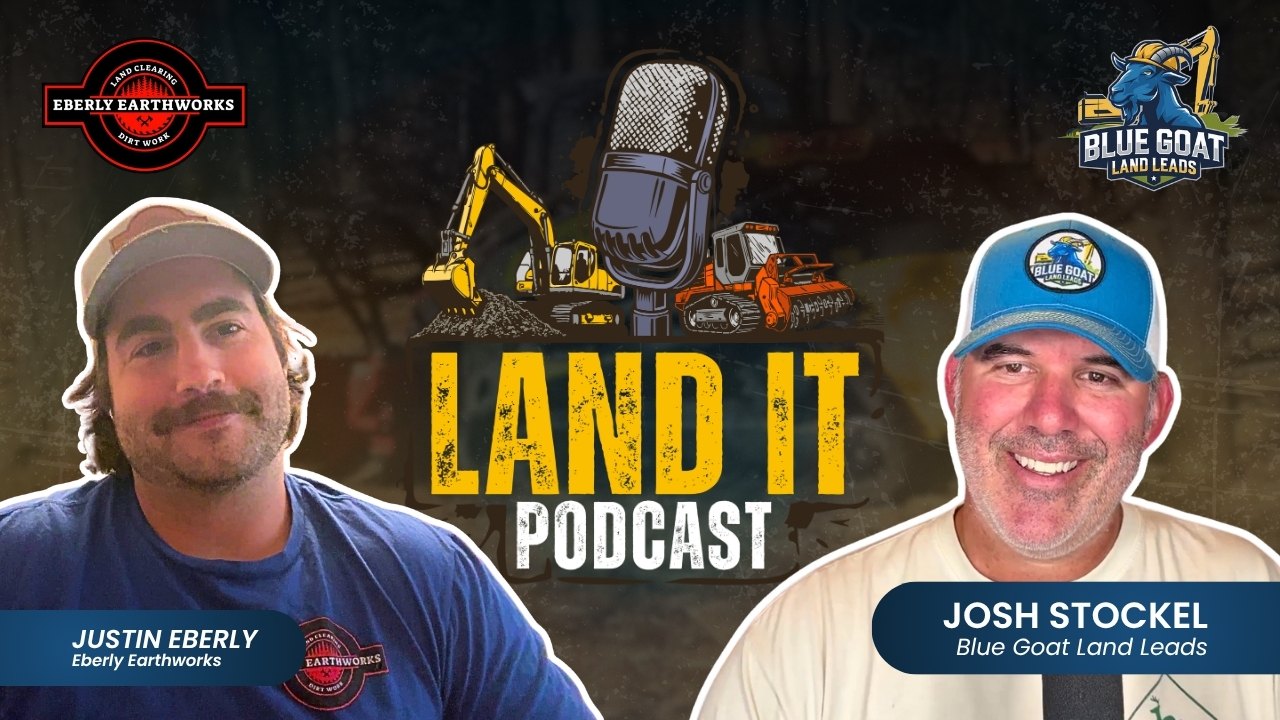
Find out what the clearing is for
Justin asks property owners what they plan to do after mulching. If they intend to build, he explains why a cleared view is not the same as a prepared pad or driveway and discusses stump removal, topsoil work and grading.
One site can support several scopes
He describes a project that progressed from removing trees and stumps to a house pad and driveway. The larger contract also included material and trucking costs, so its gross value is not the same as profit.
Play episode 13.
Price travel, wear and capacity honestly
Justin discusses the cost of mulcher teeth, repairs and travel, and says longer worthwhile jobs can justify working beyond his immediate area. As a one-person operation, he also leaves room in the calendar for breakdowns rather than stacking jobs too tightly.
Grow without losing the reason for the business
He sees room for smaller contractors serving jobs that large outfits decline, while considering trusted help for larger or simultaneous scopes. Family, reputation and a desire to leave something for his children inform how quickly he wants to expand.
A side project became a career change, not an overnight leap
Justin describes spending years in HVAC before building Eberly Earthworks. He had already used a machine for farm work and taken occasional land jobs on the side, which let him test his interest before committing to the business. He also speaks candidly about learning work he has not performed at the same scale before, drawing on curiosity about equipment and other trades. That does not mean accepting every opportunity indiscriminately. His account places the career change in a progression: hands-on exposure, smaller paid projects and a willingness to learn, followed by judgment about which larger scopes are appropriate for his current capability. The transition is more useful to readers than a simple success headline.
See the full conversation.
Declining a development job can preserve the relationship
Justin recounts being invited to consider a sizable subdivision-style project involving house lots, grading and compaction. He spent time on the possibility but ultimately told the contact he was not the right fit at that point, rather than promise a scope he could not confidently deliver. The contact later thanked him for the help and reached out again. In the discussion, Justin treats that outcome as evidence that honest limits can build trust instead of closing a door. The episode's larger upsell story therefore has an important counterweight: understanding a customer's next steps creates opportunity, but responsible scoping also requires knowing when a proposed next step exceeds your experience or resources.
Video views and booked jobs are not the same metric
When the conversation turns to marketing, Justin recalls a social video attracting a very large audience without producing a job he could identify. He does not dismiss video entirely; he continues posting work footage and acknowledges that people may discover a business through someone else's review or repeated exposure. But reach on its own does not tell a solo contractor whether a campaign is bringing suitable local prospects. He had also felt the strain of waiting to invest in marketing after launching, while relying on other work to help make ends meet. Together, those observations argue for looking at inquiries, job fit and actual booked work alongside views, not substituting one for the other.
Ideas to take back to the work
- Ask about the customer's end use before recommending mulch alone.
- A multi-scope job can have much higher gross revenue, but material, labor and travel still need to be priced.
- Leave scheduling slack when one operator and one machine carry the whole workload.
Questions from this conversation
Why isn't mulching always enough before a house build?
Justin says mulching can leave debris and stumps; building a pad or driveway may require removal and additional site preparation.
What services did Justin combine on a larger job?
He describes tree and stump removal, handling the brush, preparing a pad and building a driveway for the same customer.
How does being a solo operator affect scheduling?
Justin says he learned not to overbook because a repair or a job that runs long can delay the next commitment.
How did Justin prepare for moving from HVAC into land work?
He says he had used skid steers and excavators, had a machine for farm use and took some side jobs before making the business a full-time pursuit. He presents curiosity and continued learning as important, but his later decision to pass on a large development scope also shows that prior exposure does not qualify a new company for every job.
Why did Justin turn down a larger development opportunity?
The project involved multiple future home lots and significant grading and compaction. Justin felt the scope was beyond what he should promise at that stage, so he explained the limit instead of taking the contract. The contact later thanked him and approached him again, supporting his view that honesty about capacity can protect a relationship.